Safe nuclear power is needed more today than ever! So called “Green Energy” sources such as solar and wind power can not provide us with the required amounts of electrical power we need now or in the future. The other sources of generating are natural gas or coal fired power plants, both of which pollute our environment. Nuclear power plants are so dangerous in the minds of the public because of what happened in Fukushmia Japan on March 11th 2011. A 49 foot high tsunami breached the protective sea wall and disabled the power supply and cooling systems of the three Fukushima Daiichi reactors. Which triggered a nuclear accident where all three of the nuclear reactor cores melted in the first three days. Plus of course we must never forget the Three Mile Island accident either; in that case the nuclear reactor core partially melted down and it caused a bubble of hydrogen to develop within the containment building. The venting of building spread radiation to the nearby area surrounding the power plant. In both cases the cooling system failure was the primary cause of the meltdown.
Now that your head might be spinning a little, I think it would be a good idea to enlighten you as to my expertise in this area. My first job after graduating as a mechanical engineer from Rutgers was at a company that built boiler feedwater steam turbines and I was one of the group of people that designed them. So I am quite familiar with the workings of a nuclear power plant.
So let us proceed to the subject at hand; what is a safe way to use nuclear power? Well it turns out that the major problem with nuclear power, other than the disposal (I will address that later on) is the fact that the plant needs backup diesel generators to make sure that the coolant that keeps the reactor from melting down is kept circulating. It turns out back in the 1950s our scientists took the wrong path for generating power from atomic energy. The reactor design that we are currently using is basically like a sealed kettle of water being brought to a boil by a nuclear reaction which in turn causes steam turbines to rotate generators to make electric power. The right path would of lead us to the molten-salt reactor design which does not need to have diesel generators to keep the reactor core cool when there is a power failure.
The first experiments with molten-salt reactors (MSR) were carried out at Oak Ridge National Laboratory, in Tennessee. But because these type of reactors are not good for submarines and ships, they choose a design more suited to military application rather then civilian and thus what we have today is not good for the environment at all.
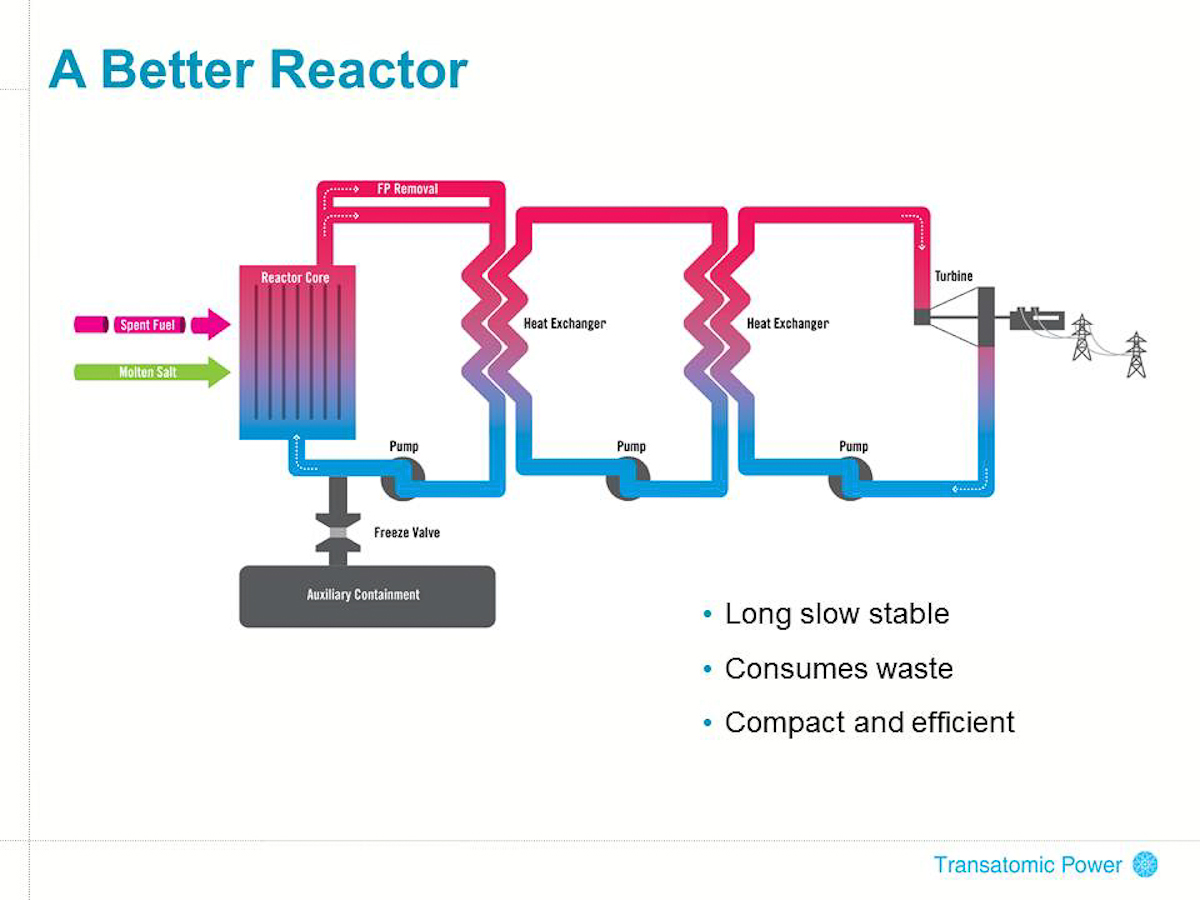
The MSR system is a failsafe design that also has another benefit; it uses nuclear waste instead of pure uranium. So no need for a storage facility for the spent nuclear rods! With its failsafe system a powered (emergency) cooling system is not needed to prevent a meltdown and would not be a factor in how safe it is anymore. Please understand that the ones pursuing MSR right now are the Chinese and not us here (Federal Government) in the United States. There is one US company that is, Transatomic, started by two MIT PhD graduates Leslie Dewan and Mark Massie. Their work shows much promise and we yet might have a US designed MSR power plant operating some time in the future.
Their design is as follows (per an article in the New Yorker), this design “dissolves the nuclear fuel in a salt mixture, which is pumped in a loop with a reactor vessel at one end and a heat exchanger at the other. In the vessel, the fuel enters a critical state, heating up the salt, which then moves on to the heat exchanger, where it cools; it then travels back to the vessel, where it heats up again. Heat from the exchanger is used to make steam, and, from this, electricity. At the bottom of the reactor vessel is a drain pipe plugged with solid salt, maintained using a powerful electric cooler. If the cooler is turned off, or if it loses power, the plug melts and all of the molten salt containing the fuel drains to a storage area, where it cools on its own. There’s no threat of a meltdown.”
Now I will just mention another form of nuclear power that has been worked on for a very long time and not achieved, Cold fusion. Fusion is what powers our Sun and is the cleanest form of nuclear energy. Cold Fusion is the holy grail of energy because it is safe and clean.
I hope that I have opened your mind to the thought that safe clean nuclear is possible.
That is my opinion- Jumpin Jersey Mike


